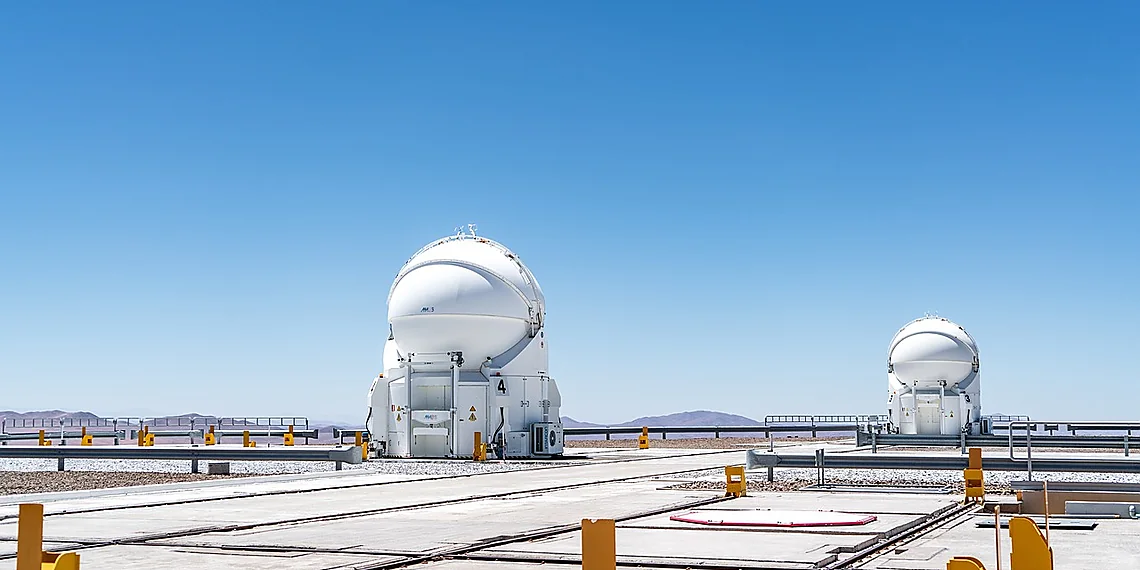



For centuries, astronomers have gazed at the night sky, piecing together a picture of the cosmos through visible light and radio waves. Now, a revolutionary new instrument is poised to redefine our understanding of the universe’s hidden architecture. We’re on the cusp of an era where previously obscured galactic structures are finally coming into view, promising unprecedented insights into how galaxies form and evolve.
The key to this breakthrough lies in a pioneering project called the K-DRIFT telescope, designed specifically to detect faint millimeter-wavelength light emitted by cold gas within galaxies. This wavelength range is typically blocked by atmospheric water vapor, making it incredibly challenging to observe – until now. The innovative design of the K-DRIFT telescope overcomes these limitations, unlocking a window into regions previously hidden from our view.
This ability to peer through the cosmic veil has profound implications for astronomy. By mapping the distribution of cold gas, we can trace the pathways of star formation and uncover the intricate details of galactic mergers – processes that shape the universe as we know it. The data gathered by the K-DRIFT telescope will undoubtedly challenge existing theories and inspire a new generation of discoveries about our place in the cosmos.
The Challenge: Seeing the Unseen
For decades, astronomers have strived to peer deeper into the universe, seeking to understand the grand structures that shape galaxies and their evolution. However, observing these faint galactic features presents a significant challenge – they emit incredibly weak light signals, often dwarfed by background noise and limitations inherent in current observational technology. Imagine trying to hear a whisper during a rock concert; that’s essentially what astronomers face when attempting to detect the subtle glow of distant galaxies.
Traditional telescopes rely on collecting photons—tiny particles of light—to form an image. The fainter the object, the fewer photons are collected. This results in a very low ‘signal-to-noise ratio,’ meaning the actual signal from the galaxy is buried within a much larger amount of random noise. Think of it like trying to find specific grains of sand on a beach – the more faint and distant the structure, the harder it becomes to distinguish its true form from the surrounding ‘sand’ of cosmic background radiation and atmospheric interference.
Existing telescopes are often limited by their lens or mirror size, which restricts how much light they can gather. Furthermore, imperfections in optics and detector sensitivity contribute to noise levels, further obscuring these faint galactic structures. While powerful instruments like the Hubble Space Telescope have revolutionized our understanding of the cosmos, even its capabilities are strained when attempting to observe the most distant and subtle features of the universe, leaving a significant gap in our knowledge.
This is precisely where the K-DRIFT telescope enters the picture. Designed specifically to overcome these limitations, it represents an innovative approach to tackling this scientific problem – offering a potential pathway to revealing previously unseen details about the formation and evolution of galaxies.
Limitations of Current Observational Technology

Traditional telescopes, while incredibly powerful, face significant challenges when attempting to observe extremely faint objects in deep space. These distant galaxies often emit very little light – far less than what our eyes could perceive even under ideal conditions. The problem is compounded by the vast distances involved; the light from these galaxies has been traveling for billions of years, resulting in a drastically weakened signal by the time it reaches Earth.
A crucial concept here is the ‘signal-to-noise ratio’. Imagine trying to hear a whisper in a crowded room – the whisper is your ‘signal’, and the background chatter is the ‘noise’. Similarly, astronomical observations are battling against natural sources of light pollution from our own atmosphere, stray radio waves, and even subtle heat fluctuations within the telescope itself. A low signal-to-noise ratio means the faint galactic light gets easily drowned out by these background disturbances, making it incredibly difficult to extract meaningful data.
Current telescopes employ various techniques like long exposure times (collecting photons for extended periods) and sophisticated filtering systems to mitigate this noise. However, there’s a fundamental limit to how much improvement can be achieved with existing technology. Even the most advanced observatories often struggle to reliably detect these faint galactic features, leaving vast portions of the universe shrouded in darkness – a problem that the K-DRIFT telescope aims to address.
K-DRIFT: A New Approach to Galactic Observation
The K-DRIFT telescope represents a significant departure from traditional astronomical observation methods, promising to reveal previously unseen details of our galaxy. Current telescopes often struggle with observing faint or diffuse galactic structures – think sprawling nebulae or the outer reaches of spiral arms – because they’re overwhelmed by brighter objects and suffer from limitations in their ability to capture subtle light variations. The K-DRIFT (which stands for Kinetic Differential Rolling Shutter Imager For Transient Phenomena) aims to solve this problem through a unique design centered around its innovative rolling shutter technology.
At the heart of the K-DRIFT telescope lies its specialized rolling shutter, which is unlike anything found in conventional telescopes. Imagine a camera taking pictures one line at a time, rapidly scanning across the scene. That’s essentially what the K-DRIFT’s rolling shutter does, but with extreme precision and speed. This allows it to effectively ‘freeze’ motion blur caused by atmospheric turbulence – a major obstacle for clear astronomical images. By capturing each line of pixels sequentially, it can correct for these distortions in real time, producing sharper images than traditional telescopes that capture an entire frame at once.
Beyond the rolling shutter, K-DRIFT incorporates specialized optics designed to maximize light sensitivity and minimize noise. These optical components are carefully engineered to gather as much faint light as possible while filtering out unwanted background signals. This combination of a high-speed rolling shutter and optimized optics allows the telescope to effectively ‘subtract’ the bright foreground objects and reveal the dimmer, previously hidden galactic structures lurking behind them. It’s like being able to filter out the city lights to finally see the stars!
The team behind K-DRIFT believes this new approach will open up unprecedented opportunities for astronomers to study the distribution of dark matter, map the structure of our galaxy’s halo, and observe faint stellar populations – all previously challenging or impossible with existing telescopes. The initial prototype demonstrates remarkable potential, and future iterations promise even greater sensitivity and resolution, ushering in a new era of galactic exploration.
Design & Technology Breakdown

The K-DRIFT (Kinematic Drift) telescope represents a significant departure from traditional astronomical observation techniques. Most telescopes use a ‘snapshot’ approach – they capture an image in one go. The K-DRIFT, however, employs a ‘rolling shutter’ system, similar to how some high-speed cameras record video. Imagine taking a photograph not all at once, but by slowly scanning the camera across the scene, line by line. This allows it to gather much fainter light over a longer period, effectively amplifying incredibly subtle signals that would otherwise be lost in the noise.
A key element enabling K-DRIFT’s sensitivity is its specialized optics. Traditional telescopes often struggle with distortions caused by atmospheric turbulence and imperfections in their lenses. The K-DRIFT utilizes a unique arrangement of mirrors and lenses designed to minimize these distortions, creating exceptionally sharp images even under less-than-ideal observing conditions. Think of it like correcting the ripples on a pond’s surface before you try to see what’s beneath – the clearer your water, the better you can see.
Beyond the rolling shutter and optimized optics, K-DRIFT incorporates an innovative kinematic drift system. This system precisely tracks the apparent motion of celestial objects across the sky as Earth rotates, compensating for this movement with incredible accuracy. This allows the telescope to maintain a constant exposure time even as the object shifts, further enhancing its ability to capture faint details. The result is an instrument capable of revealing previously unseen structures within galaxies and providing unprecedented insights into their formation and evolution.
Potential Discoveries & Future Implications
The K-DRIFT telescope promises a revolutionary leap in our ability to observe the universe’s faintest structures, potentially unlocking profound insights into some of cosmology’s biggest mysteries. Unlike existing telescopes primarily focused on bright, easily observable objects, K-DRIFT is specifically designed to detect what we currently consider ‘invisible’ – extremely low surface brightness galaxies and filaments that weave through the cosmic web. This capability opens a window onto regions previously shrouded in darkness, allowing us to piece together a far more complete picture of how large-scale structures formed and evolved.
One of the most exciting prospects is the potential for discovering vast populations of dwarf galaxies currently hidden from view. These smaller galaxies are thought to be crucial building blocks of larger galaxies like our own Milky Way, and their distribution holds vital clues about the early universe’s density fluctuations. K-DRIFT’s sensitivity could reveal previously unknown dwarf galaxy clusters, challenging existing models of galaxy formation and potentially rewriting our understanding of how cosmic structures assemble over time. Furthermore, detailed mapping of galactic filaments – those tenuous bridges connecting galaxies across vast distances – will provide unprecedented data on the distribution of dark matter, which is believed to be the scaffolding upon which these filaments are built.
Beyond revealing hidden galaxies, K-DRIFT’s observations could significantly refine our understanding of dark matter’s role in the universe. By precisely mapping the distribution of low surface brightness structures, scientists can infer the underlying gravitational influence of dark matter with greater accuracy than ever before. Discrepancies between observed structure and theoretical predictions based on current dark matter models could point towards new physics beyond the Standard Model, potentially unveiling new particles or forces that shape the cosmos.
Ultimately, K-DRIFT represents a pivotal step forward in our quest to understand the universe’s origins and evolution. Its ability to probe previously inaccessible regions promises not only spectacular discoveries but also a fundamental shift in how we perceive the cosmic landscape – allowing us to test existing cosmological models with unprecedented precision and potentially uncover entirely new phenomena that reshape our understanding of reality.
Unlocking Cosmic Secrets
The K-DRIFT telescope’s unique design, optimized for detecting extremely faint light, holds immense potential for unveiling previously unknown dwarf galaxies lurking in the cosmic shadows. These diminutive companions of larger galaxies are crucial building blocks in our understanding of galaxy formation and evolution; their abundance and distribution provide vital clues about how structures assemble over time. K-DRIFT’s sensitivity could reveal a population of these ‘dark’ galaxies, vastly increasing our census and challenging current models that struggle to account for the observed number.
Beyond individual galaxies, K-DRIFT promises unprecedented detail in mapping galactic filaments – the vast, web-like structures connecting galaxies across the universe. Current observations provide a coarse view of this cosmic web; K-DRIFT’s ability to detect faint emission lines within these filaments will allow astronomers to trace their distribution with far greater precision. This detailed mapping could reveal subtle variations in density and temperature, offering insights into the interplay between baryonic matter (the ‘normal’ stuff we see) and dark matter, which is thought to underpin the web’s structure.
Ultimately, K-DRIFT’s observations have the potential to reshape our cosmological understanding. By providing a more complete picture of galaxy formation, dark matter distribution, and the large-scale structure of the universe, it could help refine the Standard Model of Cosmology and potentially uncover new physics related to the early universe – perhaps even shedding light on phenomena like reionization or the nature of dark energy.
Beyond K-DRIFT: The Future of Low-Light Astronomy
The K-DRIFT telescope represents more than just a new instrument; it’s a glimpse into the future of low-light astronomy. Its innovative design, particularly the utilization of a rolling shutter to drastically reduce light pollution interference and improve sensitivity, offers valuable lessons for future telescope development. We’re likely to see adaptations of this core principle – the ability to ‘scan’ across the sky rapidly while collecting data – incorporated into other observatories, both ground-based and spaceborne. Imagine applying similar techniques to existing large telescopes or even developing smaller, more agile satellites dedicated to specific low-light observations; the possibilities are genuinely exciting.
Beyond simply mimicking K-DRIFT’s rolling shutter mechanism, its success highlights a broader shift in astronomical design philosophy – prioritizing sensitivity above sheer size. While enormous mirrors remain vital for certain types of observation, increasingly sophisticated techniques like those employed by K-DRIFT demonstrate that groundbreaking discoveries can be made with intelligently designed instruments, even at smaller scales. This focus on efficiency and innovation could lead to more accessible and widespread astronomical research opportunities, fostering a new generation of scientists and enthusiasts.
The impact of projects like K-DRIFT extends beyond direct replication; it validates the power of unconventional approaches. Related efforts, such as the Extremely Large Telescope (ELT) which incorporates adaptive optics to compensate for atmospheric distortion and the Nancy Grace Roman Space Telescope designed for wide-field infrared surveys, are pursuing similar goals of pushing the limits of observational capabilities. The K-DRIFT project’s success will undoubtedly inform these ongoing endeavors, encouraging researchers to explore novel techniques and design choices in their own projects.
Ultimately, the legacy of the K-DRIFT telescope may not be its specific observations (though those are sure to be significant!), but rather the inspiration it provides for future generations of astronomers and engineers. By proving that extreme sensitivity can be achieved through clever design and innovative technology, K-DRIFT is paving the way for a new era in low-light astronomy – an era where even the faintest whispers from the cosmos become audible.
Inspiring Next-Generation Telescopes
The K-DRIFT telescope’s innovative approach to light collection, particularly its use of a rolling shutter technology, offers valuable lessons for the design of future astronomical instruments. Traditional telescopes capture images with a global shutter, exposing the entire sensor simultaneously – a process susceptible to distortion from atmospheric turbulence and limiting sensitivity to faint signals. K-DRIFT’s rolling shutter scans across the image sequentially, allowing for individual frames to be rapidly corrected for this turbulence and dramatically increasing effective exposure time without accumulating noise. This principle could be adapted for larger telescopes, space-based observatories, or even incorporated into smaller, more accessible instruments for citizen science projects.
Beyond simply adopting the rolling shutter mechanism, the K-DRIFT project’s emphasis on minimizing stray light is equally crucial. The telescope’s design prioritizes blocking unwanted photons that can overwhelm faint signals from distant objects. This meticulous approach to optical design—focusing on baffles, coatings, and precise alignment—is a universal requirement for any instrument seeking to observe the faintest celestial phenomena. Future telescopes could build upon K-DRIFT’s lessons by employing advanced materials and computational modeling to further reduce stray light contamination, enhancing their ability to probe the universe’s deepest secrets.
While K-DRIFT represents a significant step forward, several other projects are also pushing the boundaries of low-light astronomy. The Extremely Large Telescope (ELT), currently under construction in Chile, aims for unprecedented sensitivity with its massive 39-meter mirror. Similarly, NASA’s Nancy Grace Roman Space Telescope will use wide-field imaging to map vast regions of the sky and search for exoplanets using microlensing techniques – both requiring extremely low noise detection systems. The success of K-DRIFT demonstrates that innovative approaches like rolling shutter technology can complement these large-scale endeavors, offering a pathway towards more accessible and efficient astronomical observations.
The journey of cosmic discovery is far from over, and projects like the K-DRIFT telescope represent a monumental leap forward in our ability to observe and understand the universe.
Its innovative design promises unprecedented insights into dark matter distribution and early galaxy formation, potentially reshaping established cosmological models and challenging current theories.
We’ve only scratched the surface of what this powerful instrument can reveal; imagine the discoveries awaiting us as data streams flow in from its sensitive sensors, painting a more detailed picture of the universe’s infancy.
The K-DRIFT telescope isn’t just about observing distant galaxies; it’s about refining our understanding of fundamental physics and pushing the boundaries of human knowledge, paving the way for future generations of astronomers and explorers alike. The implications extend beyond astrophysics, inspiring technological advancements with applications across numerous fields – a testament to the power of scientific curiosity and innovation. The pursuit of these cosmic secrets will undoubtedly drive further breakthroughs in engineering and data analysis as well, creating a ripple effect of progress throughout society. Looking ahead, we can anticipate even more ambitious space-based observatories equipped with increasingly sophisticated technology, allowing us to probe deeper into the cosmos than ever before. The future of space exploration is bright, fueled by projects like this one and the relentless human desire to uncover the universe’s mysteries. It’s an exciting time to witness such advancements and consider what wonders lie beyond our current grasp. The potential for new discoveries remains truly limitless as we continue to refine our tools and techniques for observing the cosmos around us. “ ,
Continue reading on ByteTrending:
Discover more tech insights on ByteTrending ByteTrending.
Discover more from ByteTrending
Subscribe to get the latest posts sent to your email.