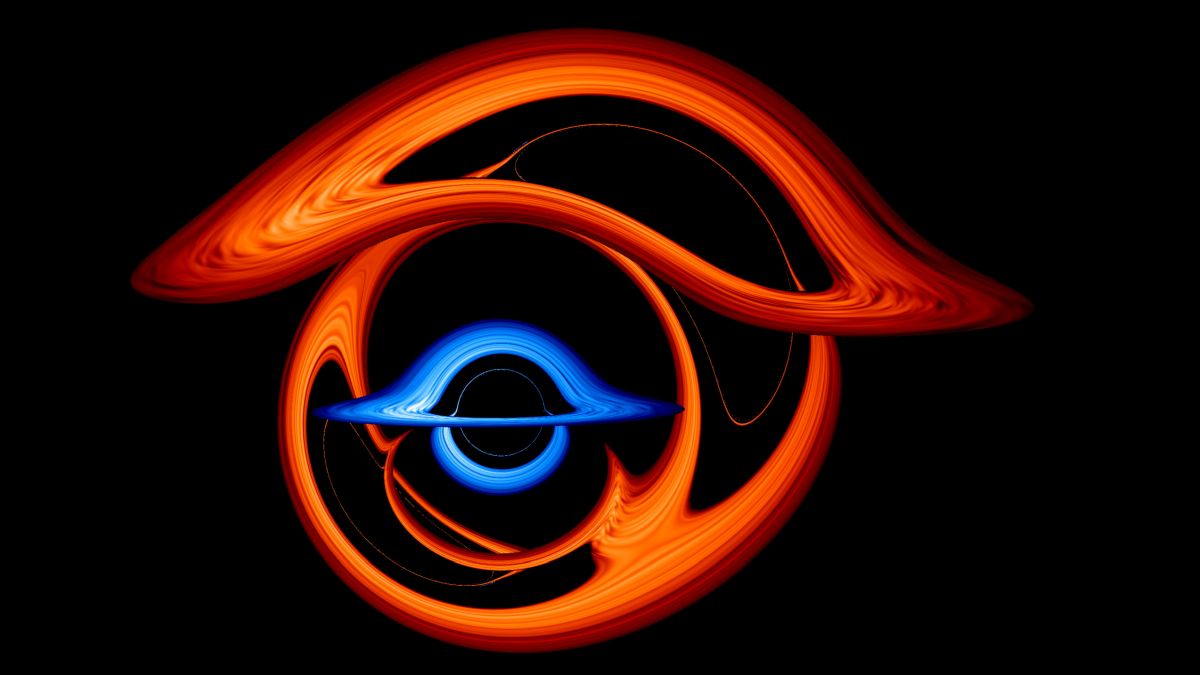



Unconventional Black Hole Merger Reveals Cosmic Secrets
For years, scientists have been detecting gravitational waves – ripples in spacetime – caused by colliding black holes. These detections largely confirm Einstein’s theory of general relativity and provide invaluable insights into these cosmic behemoths. However, a recent discovery, designated GW200208_222617, has presented an unexpected scenario: a merger with an unusually eccentric orbit—a characteristic that deviates from the standard model.

Understanding Orbital Eccentricity in Black Hole Systems
Typically, the black hole mergers detected thus far have exhibited highly circular orbits as the objects spiral closer together. Consider planets orbiting a star – they generally follow relatively round paths. However, eccentricity describes how much an orbit deviates from this perfect circle; a high level of eccentricity indicates an elongated, often oval-shaped trajectory. GW200208_222617 stands out precisely because its eccentric orbit suggests a complex and unusual history.
Possible Origins of Eccentric Orbits
The specific shape of the orbit provides valuable clues about these formative events, much like finding a fingerprint from the black hole‘s past. Several potential explanations for such eccentricities exist; for example, previous interactions with other celestial bodies could have disrupted their initial circular paths. Furthermore, densely packed star clusters are chaotic environments where gravitational interactions can significantly alter orbits. Similarly, one black hole might have been dynamically captured by another system, leading to an unusual trajectory.
Decoding GW200208_222617: A Unique Gravitational Wave Signal
Analyzing the gravitational wave signal emitted during the merger of GW200208_222617 revealed that the black holes were significantly farther apart when they first began to spiral towards each other compared to typical mergers. This larger separation, coupled with the eccentricity, resulted in a unique waveform—essentially a distinctive “sound” for this event. Consequently, scientists are using advanced AI techniques to better analyze these complex signals.
The signal’s shape indicates the black holes spent longer spiraling than usual given their masses and final distance.This discovery presents challenges to existing models of black hole formation and evolution, suggesting that our understanding of how these massive objects interact in the universe might be incomplete.
Future Research and Implications for Astrophysical Understanding
The detection of GW200208_222617 underscores the importance of continued gravitational wave astronomy. More data from observatories like LIGO, Virgo, and KAGRA will allow scientists to identify more events with eccentric orbits. Therefore, a larger sample size is needed for statistical analysis to determine how common these unusual mergers truly are. In addition, researchers need to refine their simulations to better model the formation and evolution of binary black holes exhibiting eccentric orbits.
- Statistical Analysis: Analyzing a greater number of eccentric black hole mergers will help us understand their prevalence in the universe.
- Refined Simulations: Researchers are working to develop more accurate simulations that can predict and explain the behavior of binary black holes with eccentric orbits.
- Multi-Messenger Astronomy: Combining gravitational wave observations with data from other telescopes, which observe light or other forms of electromagnetic radiation, promises even more comprehensive insights into these cosmic events.
Ultimately, studying GW200208_222617 and similar anomalies will contribute to unraveling the mysteries surrounding black hole formation, galactic evolution, and the fundamental laws governing our universe.
Source: Read the original article here.
Discover more tech insights on ByteTrending.
Discover more from ByteTrending
Subscribe to get the latest posts sent to your email.