

The quest for robots capable of traversing challenging environments has led to some truly innovative designs. Among these stands RoboBall, a unique spherical robot originally conceived by Dr. Robert Ambrose at NASA in 2003 and recently revived by Texas A&M University’s Robotics and Automation Design Lab (RAD Lab). This remarkable creation promises access to terrains previously inaccessible for wheeled or legged machines, opening doors for exploration from lunar craters to sandy beaches. The RoboBall’s design presents an exciting avenue for robotic innovation.
The Genesis of RoboBall: From NASA Concept to Texas A&M Revival
Dr. Ambrose’s initial concept, a robot with no fixed top or bottom—a perfect sphere—was born out of the need for versatile exploration capabilities. The design envisioned a robust platform capable of navigating uneven terrain and avoiding the pitfalls of traditional robotic locomotion. While initially shelved to focus on drivable rovers for astronauts, the idea lay dormant until 2021 when Dr. Ambrose joined Texas A&M University. With funding from the Chancellor’s Research Initiative and Governor’s University Research Initiative, he reignited the RoboBall project, bringing his innovative vision to life.
Early Prototypes and Design Considerations
The initial prototypes were built by two of Ambrose’s students, paving the way for future development. However, challenges remained in perfecting the design and ensuring its functionality. The core concept revolves around what’s been termed a “robot in an airbag,” providing inherent protection against impacts and facilitating navigation across rough surfaces. Furthermore, the spherical shape inherently prevents it from tipping over.
The Significance of Student Involvement
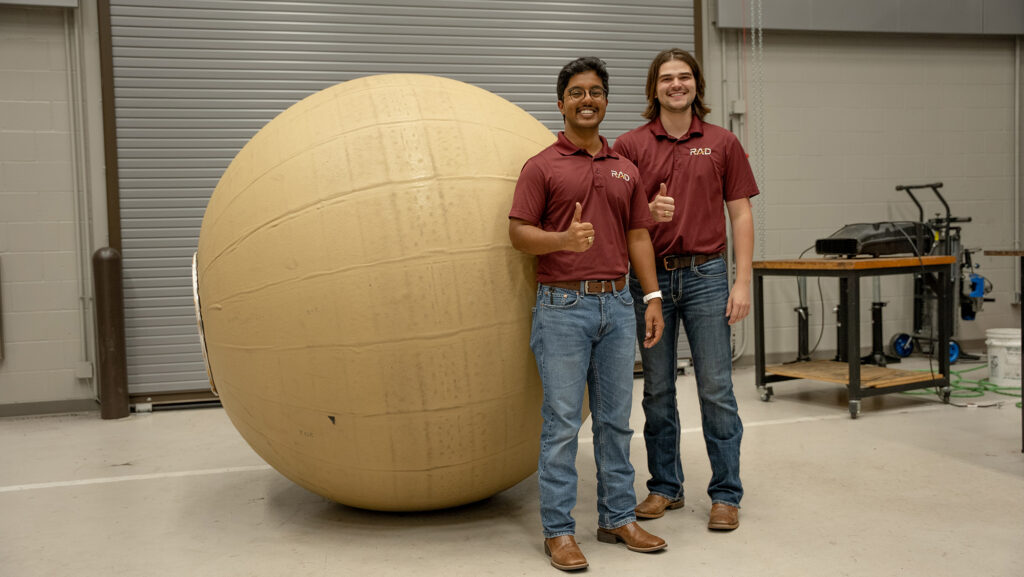
Graduate students Rishi Jangale and Derek Pravecek have become integral to the RoboBall’s resurgence, managing the project with a high degree of autonomy. They’ve embraced the opportunity to push boundaries and explore unconventional engineering solutions, highlighting the value of student-led research. Notably, they emphasize that their work extends beyond traditional textbook learning, offering practical experience in real-world engineering challenges.
RoboBall’s Design and Functionality: A Deep Dive
Two versions of RoboBall currently exist: RoboBall II serves as a platform for testing control algorithms and power output, while the larger RoboBall III, with a diameter of 6 feet, is designed to carry payloads such as sensors, cameras, and sampling tools. This allows for adaptability across various mission profiles.
Testing in Challenging Environments
The RAD Lab team plans field trials on Galveston’s beaches to demonstrate the robot’s ability to transition seamlessly from water to land. This testing will evaluate its buoyancy and terrain adaptability, proving its capabilities in a realistic setting. Traditional robots often struggle with such transitions, frequently stalling or tipping over; however, RoboBall’s spherical design allows it to roll out of the water onto sand without compromising orientation.
Unique Challenges in Maintenance and Diagnostics
The enclosed nature of the RoboBall, while providing protection, presents unique maintenance challenges. Accessing internal components requires complete disassembly, making diagnostics and repairs complex. For example, a simple motor failure necessitates taking apart the entire robot, a process likened to “open-heart surgery on a rolling ball.” Consequently, each task undertaken with RoboBall is novel, as there’s a lack of established literature for robots of this size and design.
Future Directions: Machine Learning and Autonomous Exploration
Looking ahead, Jangale and Pravecek are focusing on enhancing RoboBall’s navigation capabilities through the integration of machine learning and sensor fusion techniques. They envision a future where RoboBall can autonomously explore complex environments, collecting valuable data for scientific research and disaster relief. This pursuit reflects the team’s commitment to pushing the boundaries of robotic exploration.
In conclusion, the revival of Dr. Ambrose’s 2003 concept represents a significant advancement in robotics design. The RoboBall’s unique spherical form and student-led innovation promise a future of unparalleled exploratory capabilities.
Source: Read the original article here.
Discover more tech insights on ByteTrending.
Discover more from ByteTrending
Subscribe to get the latest posts sent to your email.