

The pace of advancements in AI models is remarkable; GPT-5, Claude Sonnet, and Gemini represent just a few recent breakthroughs, each expanding our capabilities. However, many real-world problems aren’t effectively solved by a single model operating in isolation. Increasingly, developers are recognizing the need for sophisticated systems comprised of multiple agents working collaboratively to tackle complex tasks.
For instance, imagine a research workflow where one agent diligently gathers information, another summarizes findings concisely, a planner coordinates subsequent steps, and a reviewer ensures accuracy – all functioning as part of a cohesive multi-agent system. The challenge, however, lies in the complexity of building such systems; traditional approaches often involve cumbersome integration and lack seamless context sharing.
That’s precisely what cagent aims to resolve. It simplifies the creation and management of these collaborative AI workflows, making it significantly easier for developers to harness the power of decentralized intelligence.
Understanding Multi-Agent Systems
At its core, a multi-agent system is a coordinated group of AI agents designed to collaborate on complex tasks. Unlike traditional monolithic systems, these systems leverage distributed problem-solving capabilities. With cagent, you can build and run these systems in a declarative manner—no more wrestling with intricate wiring or constant reconfiguration.
The Benefits of Decentralized Intelligence
A key advantage of using a multi-agent system is the increased robustness and adaptability it offers. For example, if one agent fails, others can compensate, ensuring continued progress. Furthermore, each agent can be specialized for specific tasks, leading to greater efficiency and improved overall performance. Consider a content creation workflow: an agent might research topics, another draft text, and yet another optimize for SEO – a far more streamlined process than relying on a single entity.
Key Components of a Multi-Agent System
Typically, a multi-agent system includes several essential components. These include individual agents with defined roles and capabilities, communication protocols facilitating interaction and data exchange, and a coordination mechanism to ensure alignment towards shared goals. Cagent simplifies the management of these components by providing a structured framework for defining agent behaviors and orchestrating their interactions.
Introducing cagent: Simplifying Multi-Agent System Development
Cagent is an open-source tool designed to streamline the creation, deployment, and sharing of agents, and it’s part of Docker’s expanding suite of AI tools. Instead of writing complex glue code to connect models, tools, and workflows, you can describe each agent—or a team of agents—using a single YAML file.
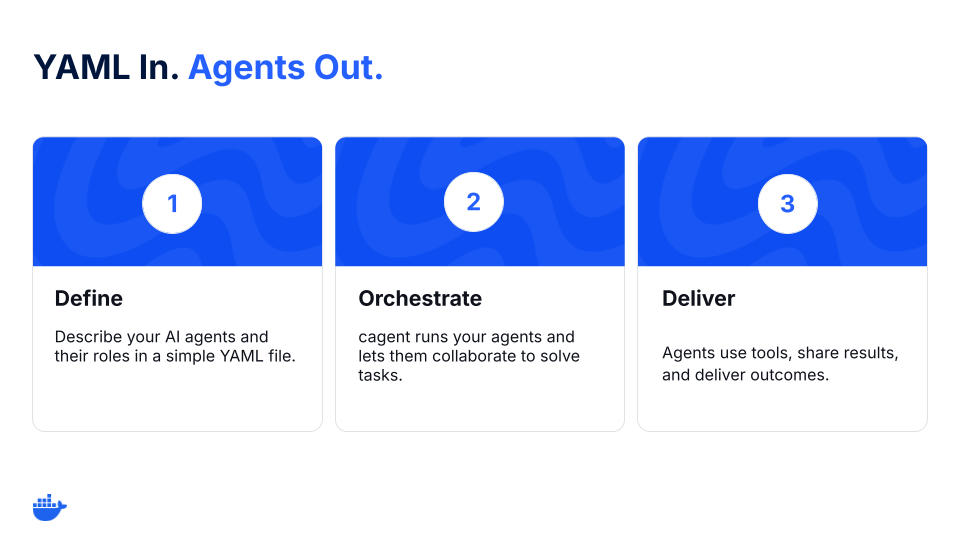
This YAML file specifies crucial details such as the model used by the agent (OpenAI, Anthropic, Gemini, or a local one), its specific role and instructions, tools it can access (like GitHub, search, or filesystem), and any sub-agents to which it delegates tasks. Consequently, agents become portable, reproducible artifacts that you can easily run anywhere and share with your team.
Addressing Common Multi-Agent Challenges
Cagent directly addresses several common challenges encountered when building multi-agent systems. It simplifies orchestration of both primary agents and their sub-agents, allowing developers to define roles and delegation hierarchies effectively. Furthermore, it provides robust tool access controls through mechanisms like MCP (Model Control Plane), ensuring that each agent operates within defined boundaries and facilitating auditability.
Flexibility and Portability with Cagent
A notable feature of cagent is its ability to seamlessly switch between different AI models, including OpenAI, Anthropic, Gemini, and local models using Docker Model Runner. This flexibility allows developers to adapt quickly to evolving model landscapes without rewriting their entire system. Moreover, the ability to package agents as self-contained artifacts promotes reproducibility and simplifies collaboration.
Building a Multi-Agent System with cagent: A Practical Example
Let’s illustrate how easy it is to create a multi-agent system using Docker cagent. The process involves defining each agent’s configuration in a YAML file, specifying its model, role, tools, and any sub-agents. Cagent then handles the orchestration, context management, and execution of these agents, resulting in a streamlined and efficient workflow.
For example, you could define an agent responsible for summarizing research papers using OpenAI’s GPT models, while another agent utilizes GitHub to track relevant code repositories. With cagent, setting up this collaboration is as simple as defining the roles and tool access rights in a YAML configuration file—a significant improvement over traditional methods.
In conclusion, cagent offers a powerful solution for building and managing multi-agent systems, democratizing access to advanced AI capabilities and empowering developers to tackle increasingly complex challenges. As the field of decentralized intelligence continues to evolve, tools like cagent will play a crucial role in shaping the future of AI development.
Source: Read the original article here.
Discover more tech insights on ByteTrending.
Discover more from ByteTrending
Subscribe to get the latest posts sent to your email.