


Understanding Graph Neural Networks (GNNs)
Graphs are ubiquitous—social networks, molecular structures, and knowledge graphs all benefit from their representation. Representing data as graphs unlocks powerful analytical possibilities; however, traditional machine learning methods often struggle to effectively utilize this structure. Enter Graph Neural Networks (GNNs), a class of neural network architectures specifically designed for graph-structured data. This article provides an accessible introduction to GNNs, explaining their core components and potential applications.
The Building Blocks: Nodes, Edges, and Messages
Before delving into the architecture, let’s define some key terms. A graph comprises nodes (also called vertices) connected by edges. Nodes represent entities—users in a social network, atoms in a molecule—while edges represent relationships between them.
Node Features
Each node can have associated features—information describing the node. For example, in a social network, features might include age, location, or interests. These features are represented as vectors and provide initial information to the GNN. Consequently, they significantly impact the network’s ability to learn meaningful representations.
Edge Features
Similarly, edges can also possess features representing properties of the relationship between nodes. In a molecule, this could be bond type or length. Edge features enrich the graph representation with relational context and allow for more nuanced analysis.
Message Passing: The Heart of GNNs
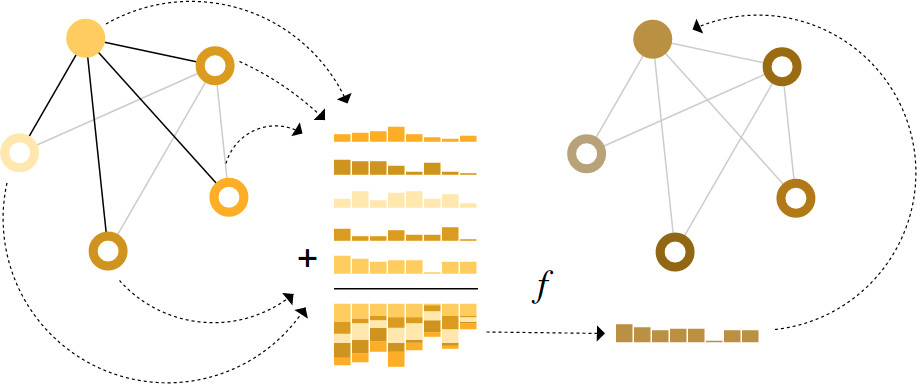
The core mechanism in GNNs is message passing (also called neighborhood aggregation). Each node aggregates information from its neighbors, transforming and combining it to update its own representation. This process repeats for several iterations, enabling nodes to gather information from increasingly distant parts of the graph. Therefore, message passing allows for global context integration.
How GNNs Work: A Layer-by-Layer Approach
A GNN layer essentially performs a message passing step. The general process involves three key steps:
- Message Generation: Each node generates a message to its neighbors based on its own features and, optionally, the edge feature connecting them. This often involves a neural network layer.
- Aggregation: Each node aggregates the messages received from its neighbors. Common aggregation functions include sum, mean, max, or more complex learned aggregators. Furthermore, different aggregation methods can impact the final representation’s quality.
- Update: The aggregated information is combined with the node’s own features to update the node’s representation. Again, a neural network layer is typically used for this transformation. As a result of these updates, nodes progressively refine their understanding of their surroundings.
Multiple GNN layers are stacked together, allowing nodes to propagate information across the graph and learn increasingly complex representations. This layered architecture is what allows gnns to model intricate relationships.
Applications & Why They Matter
GNNs are rapidly gaining traction in various fields:
- Social Network Analysis: Node classification (e.g., identifying fake accounts), link prediction (e.g., suggesting friends).
- Drug Discovery: Predicting molecular properties, generating novel drug candidates.
- Recommender Systems: Suggesting items based on user-item graph relationships.
- Computer Vision: Scene understanding and object detection by representing scenes as graphs.
The ability to leverage relational information makes GNNs uniquely suited for these tasks, often outperforming traditional machine learning methods. For example, in drug discovery, gnns can predict the properties of molecules with greater accuracy than previous techniques.
Conclusion
Graph Neural Networks offer a powerful approach to learning from graph-structured data. By leveraging message passing and neighborhood aggregation, they can uncover complex relationships and patterns that are hidden in traditional representations. As research progresses, we can expect to see even more innovative applications of gnns across diverse domains. Ultimately, the power of gnns lies in their ability to represent and reason about relational data effectively.
Source: Read the original article here.
Discover more tech insights on ByteTrending.
Discover more from ByteTrending
Subscribe to get the latest posts sent to your email.