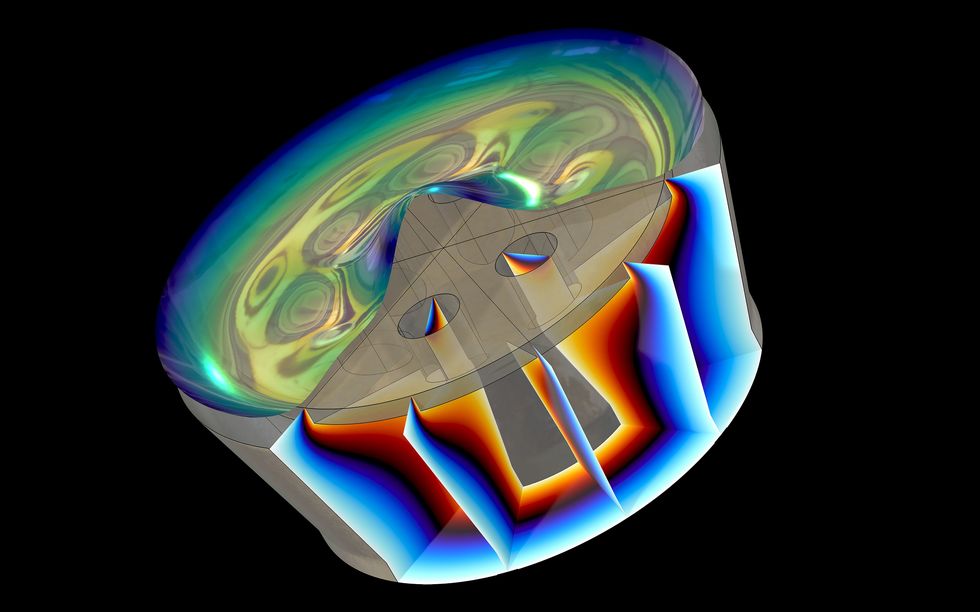



Physics simulations often present a significant challenge: the time required to generate results. This hurdle becomes even more pronounced when tackling multiphysics problems—situations involving intricate interactions between thermal, mechanical, and electromagnetic forces. The demand for realistic, high-fidelity simulations alongside real-time decision-making can feel like an impossible balance.
However, engineers are discovering innovative solutions to this problem, as highlighted in recent discussions at the COMSOL simulation software conference. The central focus is accelerating multiphysics simulations and bringing them closer to a ‘real-time’ capability. Ultimately, these advancements revolutionize how we approach complex engineering challenges.
Understanding Surrogate Models for Accelerated Simulations
One key technology driving this shift is the use of “surrogate models.” These are essentially compressed versions of full multiphysics simulations, employing machine learning techniques to provide rapid evaluations. Bjorn Sjodin, Senior Vice President of Product Management at COMSOL, explains that surrogate models distill a detailed simulation into a more compact format for faster calculations. Furthermore, the broader industry recognizes this computational bottleneck; a recent review in Procedia Computer Science highlighted how high-fidelity simulations can consume weeks to complete across various sectors.
The Process of Creating Surrogate Models
Typically, creating surrogate models involves strategically sampling data from the original model and training a faster approximation based on that data. This allows for near-instantaneous evaluation compared to solving the complete model—a significant advantage when waiting 15 minutes or longer for results is unacceptable. Notably, this approach captures essential system behaviors without the extensive computational overhead of running the full simulation every time.
Industry Applications of Surrogate Models
The benefits of surrogate models extend across numerous industries. For example, European automotive manufacturers utilize COMSOL’s surrogate models to simulate electric vehicle battery packs in real-time, facilitating faster and more informed management decisions. Similarly, a Swiss institute has developed a COMSOL-powered app for Indian farmers that predicts food spoilage in cold storage, leading to a remarkable 20% reduction in waste.
Beyond Machine Learning: Exploring Model Order Reduction (MOR)
COMSOL’s approach extends beyond just machine learning; they also utilize techniques known as “reduced order models” (ROMs). These methods involve mathematical pattern recognition and equation simplification, further accelerating the simulation process. ROMs can be broadly categorized into intrusive approaches (modifying governing equations) and non-intrusive approaches (analyzing existing data).
Intrusive vs. Non-Intrusive ROM Approaches
Recent research has demonstrated that combining neural networks with traditional ROM techniques can lead to computational speedups of up to 100,000 times compared to standard simulations. This represents a paradigm shift in how engineers can approach complex problems and make decisions based on simulation results. Therefore, the combination offers unprecedented efficiency.

Conclusion: The Future of Simulation
The evolution of simulation technology, particularly with the adoption of surrogate models and ROM techniques, is fundamentally changing how engineers work. By drastically reducing simulation times, these innovations are not only improving efficiency but also enabling new possibilities for real-time decision-making across diverse industries—from automotive to agriculture. Consequently, we can anticipate even more sophisticated applications of these techniques in the future.
Source: Read the original article here.
Discover more tech insights on ByteTrending.
Discover more from ByteTrending
Subscribe to get the latest posts sent to your email.