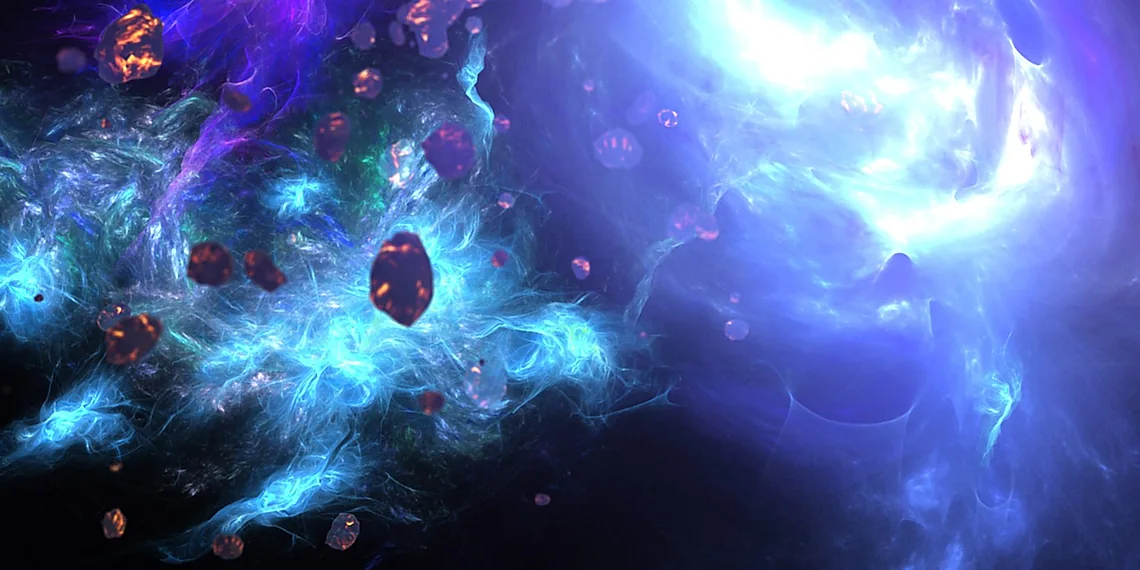

Imagine a cosmic cloud, swirling with gas and dust, illuminated by an ethereal glow – that’s a glimpse into a stellar nursery.
These breathtaking regions are the cradles of stars, vast areas within galaxies where new suns ignite from collapsing molecular clouds.
Understanding stellar nurseries is absolutely crucial for piecing together the story of our universe’s evolution; they represent active zones where star birth occurs and shapes galactic structures.
For centuries, these processes remained largely hidden, but recent advancements in infrared and radio astronomy are revolutionizing what we can observe, allowing us to peer through obscuring dust clouds and witness the intricate details of stellar formation firsthand. We’re now able to study the conditions that trigger star birth with unprecedented clarity.

What are Stellar Nurseries?
Let’s delve into where stars are born – places astronomers affectionately call ‘stellar nurseries.’ These aren’t literal daycare centers for baby stars, but rather vast regions of space brimming with the raw materials needed for star formation. Scientifically speaking, stellar nurseries are predominantly giant molecular clouds (GMCs). Think of them as colossal reservoirs of gas and dust, mostly hydrogen and helium, scattered throughout galaxies like our own Milky Way. These aren’t small pockets; they can span hundreds of light-years across and contain enough material to form thousands, even millions, of stars! The term ‘molecular’ refers to the fact that the gas within these clouds is primarily in molecular form – meaning atoms have joined together to create molecules – allowing for complex chemical reactions to occur.
So, what makes a GMC special? It’s all about density and gravity. While space generally seems empty, inside a GMC, the material is incredibly dense compared to the surrounding interstellar medium. Imagine a room filled with cotton balls – that’s roughly the density difference we are talking about! This increased density creates higher pressure. Over time, these regions within the GMC become unstable; gravity begins to overcome this internal pressure, causing the cloud to collapse in on itself. This isn’t a uniform collapse – it’s often uneven and turbulent, leading to fragmentation where larger clumps break off and begin their own gravitational descent.
As these clumps collapse further, they heat up due to the compression of gas. This heated core continues to pull in more material from the surrounding cloud, growing denser and hotter until nuclear fusion ignites – the moment a protostar is born! It’s important to note that star birth isn’t an instantaneous process; it can take millions of years for a single star to fully form within a stellar nursery. And many stars are born at once, making these regions incredibly active and dynamic environments filled with swirling gas, dust, and nascent stars.
Understanding stellar nurseries is crucial for astronomers seeking to unravel the mysteries of our universe’s evolution. By studying these cosmic wombs, we gain insights into how galaxies form, how elements heavier than hydrogen and helium (the building blocks of planets and life) are created within stars, and ultimately, how our own solar system – and ourselves – came to be.
Giant Molecular Clouds: The Cosmic Womb

Giant Molecular Clouds (GMCs) are vast reservoirs of gas and dust, often spanning hundreds of light-years across and containing millions of times the mass of our Sun. Primarily composed of molecular hydrogen (H2), they also contain helium, trace amounts of heavier elements, and microscopic dust grains – these grains play a crucial role in shielding the molecules from harmful ultraviolet radiation. The ‘molecular’ designation signifies that the hydrogen is not in its atomic form but has bonded together into molecules, which only occurs at very low temperatures, typically around 10-20 Kelvin (-263 to -253 degrees Celsius).
The immense size and density of GMCs are key to star birth. While seemingly diffuse, these clouds have regions with significantly higher densities than the average interstellar medium. Think of it like a vast, fluffy cloud – some areas are denser than others. These dense clumps within a GMC experience gravitational collapse. Gravity is always at work, pulling matter together, but in less dense environments, outward pressure (from gas and radiation) prevents collapse. However, when density increases enough, gravity overcomes this pressure, initiating the process of star formation.
The concept of density and pressure is crucial here: higher density means more material packed into a given space, increasing gravitational pull. As a clump within a GMC collapses, its density rises, further strengthening the gravitational attraction. This runaway collapse leads to the formation of dense cores – the seeds from which stars eventually emerge. The colder temperatures also contribute; lower temperature means slower particle movement and less pressure resisting gravity’s pull.
Observational Breakthroughs & Technologies
For centuries, star birth has been shrouded in mystery, obscured by thick clouds of gas and dust that block visible light. Understanding these cosmic cradles required more than just powerful telescopes; it demanded a revolution in observational technology. Recent decades have seen incredible advancements allowing astronomers to pierce through this veil and witness the breathtaking process of stars being born. This isn’t merely about seeing further, but *seeing differently*, unlocking secrets previously hidden from our view.
The James Webb Space Telescope (JWST) has undeniably been a game-changer in this field. Its primary mission is to observe infrared light, a wavelength that can penetrate the dense dust clouds where stars are born. Visible light struggles to pass through these regions, but infrared radiation does, revealing the intricate details of stellar nurseries like never before. Webb’s Near-Infrared Camera (NIRCam) and Mid-Infrared Instrument (MIRI), among others, have captured stunning images showing protostars embedded within pillars of gas and dust, jets of material ejected from forming stars, and swirling disks of matter coalescing into planetary systems – all previously invisible to us.
Complementing JWST’s observations is the Atacama Large Millimeter/submillimeter Array (ALMA). While Webb focuses on infrared light, ALMA specializes in observing millimeter and submillimeter wavelengths. These longer wavelengths are sensitive to the cold gas and dust that make up stellar nurseries, providing crucial information about their composition, temperature, and velocity. By combining observations from JWST and ALMA – seeing both the warm, glowing protostars and the surrounding cold gas – astronomers gain a far more complete picture of how stars form. This synergy allows us to map out the intricate dance of matter as it collapses under gravity’s influence.
Beyond these flagship missions, advancements in adaptive optics on ground-based telescopes further enhance our ability to resolve fine details within stellar nurseries. These technologies correct for atmospheric distortions, essentially creating a clearer window into space. The combined power of JWST, ALMA, and improved ground-based observatories is ushering in a golden age for star birth research, promising even more groundbreaking discoveries as we continue to unravel the mysteries of how stars ignite.
Webb’s Infrared Vision: Peering Through Dust

Stellar nurseries – vast clouds of gas and dust where stars are born – are notoriously difficult to observe directly. Visible light is easily scattered and absorbed by the dense material within these regions, effectively creating a cosmic veil that obscures the processes unfolding inside. However, infrared light possesses longer wavelengths than visible light, allowing it to penetrate this dusty barrier and reveal what lies hidden beneath. Telescopes like the James Webb Space Telescope (JWST) are specifically designed to detect this infrared radiation, providing an unprecedented view into these stellar cradles.
The ability of JWST to observe in the infrared has led to groundbreaking discoveries. Previously unseen structures within nebulae, such as protostellar jets and outflows – powerful streams of gas ejected from young stars – have been directly imaged. These observations allow astronomers to study how stars accrete mass and angular momentum during their formation, shedding light on the early stages of stellar evolution. Furthermore, Webb’s infrared capabilities are revealing complex organic molecules present in these nurseries, hinting at the building blocks of future planetary systems.
One particularly stunning example is JWST’s observations of the Pillars of Creation within the Eagle Nebula. While Hubble previously captured iconic images of this region, Webb’s infrared view has pierced through the dust to reveal intricate details of star formation occurring *within* those pillars – showing newborn stars emerging from their dusty cocoons and illuminating surrounding gas clouds in breathtaking detail. These visuals are not merely aesthetically pleasing; they provide critical data for understanding the dynamics of star birth and the environments where planets may form.
The Star Formation Process – Step-by-Step
The journey from diffuse cloud of gas and dust to a shining star is an incredibly intricate process – one that spans millions of years and involves fundamental forces shaping the universe. Understanding how stars are born, or experiencing ‘star birth’, requires breaking down this complex sequence into manageable stages. It all begins with massive molecular clouds, vast regions within galaxies composed primarily of hydrogen and helium, interspersed with dust grains. These clouds aren’t perfectly uniform; slight density variations act as gravitational seeds, initiating the collapse process where gravity’s pull overcomes internal pressure.
The initial collapse isn’t a smooth event. As a cloud fragment begins to shrink under its own weight, it often fragments further into smaller clumps – each potentially destined to become a star or even a multiple-star system. This fragmentation is driven by the increasing density and the formation of complex structures within the collapsing material. As these clumps contract, they spin faster (think of an ice skater pulling their arms in), leading to the formation of a swirling disk of gas and dust known as an accretion disk around a central core – the budding protostar. This disk plays a crucial role in feeding the growing star.
The protostar phase is characterized by continued growth through material accreting from the surrounding disk. Initially, energy generation within the protostar comes solely from gravitational contraction; as the core compresses, it heats up dramatically. Eventually, temperatures and pressures reach a critical threshold – roughly 10 million degrees Celsius – that allows nuclear fusion to ignite. This is the ‘ignition’ point where hydrogen atoms begin fusing into helium, releasing immense amounts of energy and marking the true birth of a star. The outward pressure from this nuclear reaction then balances the inward pull of gravity, achieving hydrostatic equilibrium – a stable state for the star.
Once on the main sequence – the longest and most stable phase in a star’s life – the rate of hydrogen fusion remains relatively constant. This stability is what allows stars to shine brightly for billions of years. The characteristics of the resulting star—its mass, luminosity, temperature, and lifespan—are largely determined by the initial size and composition of the cloud fragment from which it formed. Studying these stellar nurseries helps us understand not only how our own Sun came into being but also provides invaluable insights into the evolution of galaxies.
From Collapse to Ignition: A Stellar Timeline
The journey of a star begins within vast molecular clouds – cold, dense regions primarily composed of hydrogen and helium gas. These clouds aren’t uniform; slight density fluctuations trigger gravitational collapse. Imagine a loosely packed pile of snow—a gentle nudge can cause it to avalanche downhill. Similarly, these overdense pockets within the cloud begin to pull in surrounding material due to gravity’s relentless force. As the cloud collapses, it fragments into smaller clumps, each destined to become a star or multiple stars.
These collapsing clumps form protostars – embryonic stars still gathering mass from their surroundings. A swirling disk of gas and dust, called an accretion disk, forms around the protostar as material falls inward. Think of water circling a drain; the spinning motion conserves angular momentum, flattening the material into a disk-like structure. This disk not only feeds the growing protostar but also serves as the birthplace for potential planets. The protostar phase is characterized by intense heat and radiation as gravitational energy converts into thermal energy.
The pivotal moment arrives when the core temperature and pressure of the protostar become high enough to initiate nuclear fusion – the process where hydrogen atoms fuse to form helium, releasing tremendous amounts of energy. This ignition marks the true ‘birth’ of a star. The outward pressure generated by this fusion now balances the inward pull of gravity, establishing hydrostatic equilibrium—a stable state where the forces are perfectly balanced. It’s like balancing a balloon; the air pressure inside pushes outwards against the rubber, maintaining its shape and size.
Future Directions & Unanswered Questions
Despite the incredible progress made by missions like Hubble, James Webb, and ALMA, our understanding of star birth remains far from complete. Ongoing research focuses on refining models of molecular cloud collapse – the initial stage where vast clouds of gas and dust begin to fragment and coalesce under their own gravity. Scientists are particularly keen to understand the role of magnetic fields and turbulence in regulating this process; these factors can either accelerate or inhibit star formation, leading to variations in stellar populations within a single nursery. Detailed simulations, combined with observations across multiple wavelengths (from radio to infrared), are crucial for disentangling these complex interactions.
A particularly exciting frontier is the investigation of planet formation *within* stellar nurseries. We now know that planets form from protoplanetary disks – swirling structures of gas and dust surrounding young stars. Observing these disks at their earliest stages, within the chaotic environment of a star-forming region, offers unparalleled insights into the conditions that shape planetary systems. Future missions like the proposed Origins Space Telescope are specifically designed to probe the composition and structure of these protoplanetary disks with unprecedented sensitivity, searching for signatures of organic molecules – the building blocks of life.
The search for exoplanets forming directly within stellar nurseries presents a significant technological challenge. The dense gas and dust can obscure our view, making it difficult to detect faint planetary signals. However, advancements in adaptive optics and infrared interferometry are slowly overcoming these limitations. Identifying planets at such an early stage of development could revolutionize our understanding of planet formation pathways, revealing whether the conditions that give rise to Earth-like worlds are common or rare throughout the galaxy.
Looking further ahead, future space telescopes equipped with coronagraphs – instruments designed to block out the light from a star – will be instrumental in directly imaging exoplanets forming within stellar nurseries. This would allow us to study their atmospheres and potential habitability directly, providing invaluable data for assessing the prevalence of life beyond Earth. The continued exploration of these cosmic cradles promises not only to deepen our knowledge of star birth but also to reshape our understanding of planetary systems and our place in the universe.
The journey through stellar nurseries has revealed a breathtaking complexity, showcasing how gravity, gas, and dust collaborate to orchestrate the magnificent process of star birth.
We’ve seen firsthand that these cosmic cradles are not merely beautiful images; they’re dynamic laboratories where fundamental physics is constantly at play, shaping the galaxies we observe today.
Understanding the intricacies of this formation—from the initial collapse of molecular clouds to the ignition of nuclear fusion within a newborn star—provides crucial insights into our own origins and the evolution of the universe itself.
Future telescopes, equipped with even greater sensitivity and resolution, promise to peel back more layers of these stellar nurseries, potentially revealing entirely new mechanisms driving star birth and challenging existing models. Imagine what we might discover about planetary system formation in these early stages—the possibilities are truly astounding! The data streaming in from missions like JWST is already revolutionizing our field, constantly rewriting textbooks and inspiring new questions to ask about the cosmos’s earliest chapters..”,
Continue reading on ByteTrending:
Discover more tech insights on ByteTrending ByteTrending.
Discover more from ByteTrending
Subscribe to get the latest posts sent to your email.