
For decades, the dream of effortlessly crossing continents in a fraction of the time has lingered just out of reach, hampered by noise concerns and regulatory hurdles. The sonic boom—that unmistakable wallop that accompanies faster-than-sound travel—has effectively grounded widespread commercial supersonic flight, relegating it to the realm of Concorde nostalgia. But what if we could recapture that speed without the disruptive roar? NASA’s X-59 project is poised to potentially revolutionize air travel and bring us closer than ever before to a new era of efficient global connectivity. This isn’t just about going fast; it’s about reimagining how we fly.
The key lies in drastically reducing, or even eliminating, that infamous sonic boom. Enter the X-59, a uniquely shaped experimental aircraft designed and built through a groundbreaking partnership between NASA and Lockheed Martin. Its innovative design actively shapes the sound waves generated during flight, aiming to transform the traditional ‘boom’ into a softer ‘thump,’ or ideally, nothing at all. This represents a monumental shift in engineering and promises to unlock new possibilities for supersonic aircraft.
The X-59 isn’t intended to be a commercial airliner itself; rather, it serves as a crucial testbed. Data gathered from its flight trials will inform future regulations regarding noise levels allowed for supersonic travel, paving the way for potential commercial applications. Imagine a world where transatlantic flights take mere hours – that’s the ambitious vision this project aims to realize. We’ll delve into the details of this incredible undertaking and explore how it could reshape the future of air transportation.
The Quest for Quiet Supersonic Travel
The dream of crossing continents in a fraction of the time has long been intertwined with supersonic flight, yet its history is marred by a significant obstacle: the sonic boom. Supersonic aircraft, those capable of exceeding the speed of sound (approximately 767 mph), generate intense shockwaves as they travel – these are what we experience as sonic booms. The Concorde, famously known for its rapid transatlantic journeys, was ultimately retired in 2003 largely due to these disruptive booms, which were deemed unacceptable over populated areas. Regulations across most developed nations now strictly limit supersonic flight over land precisely because of the noise pollution and potential damage caused by these powerful sound waves.
The impact goes beyond mere annoyance. Sonic booms can rattle windows, trigger car alarms, and even cause structural stress to buildings. These effects understandably sparked significant public outcry, leading to stringent regulations that effectively grounded commercial supersonic travel for decades. While the Concorde was a technological marvel, its operational limitations – primarily restricted to transatlantic routes over water – significantly hampered its profitability and ultimately contributed to its demise. The desire for widespread supersonic flight necessitates a fundamental shift in how these aircraft generate and manage sound.
The current resurgence of interest in supersonic travel isn’t ignoring this historical challenge; it’s actively tackling it head-on. Scientists and engineers are now focused on minimizing, or even eliminating, the sonic boom. This involves innovative designs that manipulate airflow around the aircraft to reduce the intensity of shockwaves. The Lockheed Martin X-59, developed in partnership with NASA, represents a significant step forward in this quest. Its unique shape is specifically engineered to lessen the boom to what researchers hope will be perceived as a gentle ‘thump’ – a dramatic improvement over the jarring impact of traditional supersonic flight.
Ultimately, the future of supersonic aircraft hinges on developing quieter technologies. If NASA and Lockheed Martin’s X-59 program proves successful in significantly reducing the sonic boom, it could pave the way for a new era of commercial supersonic travel, potentially connecting cities across continents with unprecedented speed while minimizing environmental and societal disruption. The ability to overcome this long-standing challenge is crucial not only for reviving supersonic flight but also for demonstrating how innovation can address historical limitations and unlock new possibilities in aerospace engineering.
Sonic Boom Woes: A History

The jarring crack of a sonic boom has historically been the biggest obstacle to widespread supersonic aircraft travel. A sonic boom isn’t just a loud noise; it’s a sudden pressure change that radiates outwards from an aircraft traveling faster than the speed of sound (Mach 1). These shockwaves can rattle windows, startle people and animals, and even damage sensitive equipment. The Concorde, for example, while celebrated for its speed, faced significant public backlash due to the disruptive sonic booms it created over populated areas.
The impact of these booms led to strict regulations severely limiting supersonic flight. In 1977, the United States banned all supersonic aircraft from flying overland, effectively restricting Concorde flights primarily to transatlantic routes and rendering domestic supersonic travel impossible. Similar restrictions exist in many other countries. These rules weren’t arbitrary; they were a direct response to community complaints and concerns about potential structural damage caused by frequent sonic booms.
Current regulations remain largely unchanged. The Federal Aviation Administration (FAA) prohibits commercial supersonic flight over land unless specific waivers are granted, which require demonstrating significantly reduced noise levels. NASA’s X-59 program directly addresses this challenge – aiming to reduce the perceived sonic boom to a ‘sonic thump,’ potentially paving the way for future regulatory changes and opening up opportunities for overland supersonic travel.
Introducing the X-59: NASA’s Quiet Pioneer
The Lockheed Martin X-59 represents a bold leap forward in aerospace engineering, aiming to revive supersonic flight without the disruptive sonic booms that grounded commercial efforts decades ago. This experimental aircraft, developed in partnership with NASA, isn’t just about speed; it’s about achieving that speed quietly. Its very design is predicated on minimizing the intense pressure waves associated with breaking the sound barrier, potentially paving the way for a future where supersonic travel over land becomes a reality.
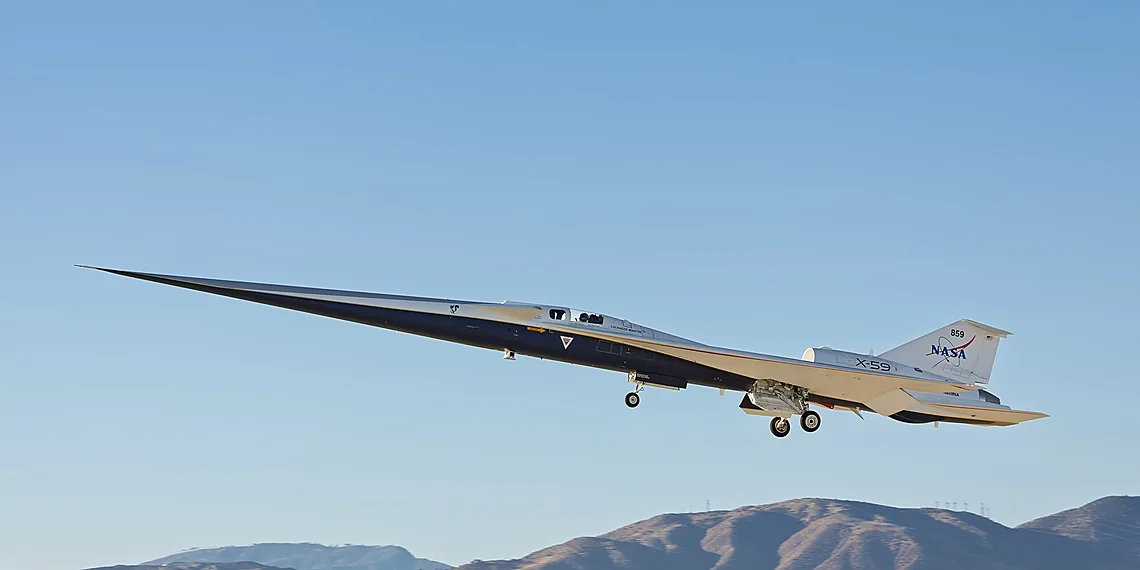
The X-59’s most striking feature is its distinctive ‘X-shape’. This isn’t merely an aesthetic choice; it’s a meticulously engineered solution to sonic boom reduction. The elongated nose extends significantly beyond the cockpit, carefully shaping and diffusing the shockwaves that form as the aircraft travels through the air. As the plane flies faster than sound, these shockwaves typically coalesce into a single, loud ‘boom’. However, the X-59’s design attempts to stretch those waves out into a much gentler ‘thump,’ or even just a perceived pressure change.
Aerodynamically, the X-shape works by manipulating airflow. The long nose creates a series of smaller shockwaves that gradually merge downstream, weakening their combined impact. The carefully sculpted fuselage further contributes to this effect, guiding air in a way that minimizes turbulence and reduces overall noise. While it resembles an older fighter jet in some aspects, its internal design and the advanced materials used are entirely modern, optimized for both performance and quiet operation. This represents a significant departure from traditional supersonic aircraft designs.
The first subsonic test flight marked a critical milestone, but the true potential of the X-59 will be revealed as it progresses towards supersonic testing. NASA’s plans involve flying the X-59 over communities to gauge public perception of the reduced sonic boom – crucial data for future regulatory approvals and the eventual commercialization of quieter supersonic aircraft. The success of this project could revolutionize air travel, bringing faster speeds without the disruptive noise that previously made it untenable.
Engineering a Whisper: Design Details

The X-59’s most striking feature is its uniquely sculpted shape, designed specifically to mitigate the intense shockwaves that create a traditional sonic boom. Unlike conventional supersonic aircraft which generate a sharp pressure spike as they break the sound barrier, the X-59 aims to spread this pressure change out over a larger area and longer period of time, resulting in what’s intended to be perceived as a ‘sonic thump’ rather than a disruptive boom. This is achieved through extensive aerodynamic shaping – essentially manipulating airflow around the aircraft.
The key to this design lies in its ‘X-shape’. The elongated nose extends far forward, creating a series of carefully controlled pressure waves that gradually coalesce and weaken before reaching the tail section. A curved upper surface then directs these weakened waves downwards, further diffusing them into the atmosphere. This complex interplay of shapes ensures that the pressure disturbance is spread horizontally instead of concentrated vertically, reducing boom intensity at ground level. The aircraft’s overall length-to-wing span ratio also contributes to this effect.
Specifically, engineers utilized computational fluid dynamics (CFD) and wind tunnel testing extensively during the X-59’s design process. They focused on minimizing wave drag and carefully managing pressure distribution across the fuselage. Preliminary data suggests that the X-59 can reduce perceived boom levels to around 70 decibels – roughly equivalent to a car door slamming – a significant improvement over the 100+ decibel booms produced by older supersonic aircraft like Concorde.
First Flight and Future Testing
The highly anticipated first flight of Lockheed Martin’s X-59 quiet supersonic aircraft has successfully taken place over California’s Mojave Desert, marking a pivotal moment in NASA’s quest to revolutionize air travel. While the initial test was conducted at subsonic speeds—reaching just 270 mph and climbing to 45,000 feet—it provided invaluable data on the aircraft’s handling characteristics and overall systems performance. The flight lasted approximately 13 minutes and demonstrated that the X-59 can safely take to the skies, a critical step before attempting supersonic speeds.
This initial success is far more than just a simple flight; it’s validation of years of innovative design and engineering focused on minimizing the disruptive sonic boom traditionally associated with supersonic travel. The X-59’s unique shape is specifically engineered to manipulate airflow, theoretically transforming the loud ‘boom’ into a gentler ‘thump,’ potentially opening doors for commercial supersonic flights over land – something currently prohibited due to noise regulations. Data gathered from this first flight will be crucial in refining these aerodynamic models and predicting the actual ground-level sound profile.
Looking ahead, NASA and Lockheed Martin have a comprehensive testing program planned. Future tests will incrementally increase speeds, gradually pushing towards supersonic velocities while meticulously monitoring performance and sonic boom characteristics. These subsequent flights are expected to involve community engagement, with NASA planning ‘quiet booms’ demonstrations over select locations in the coming months to gather feedback from residents. The ultimate goal is to provide data that informs potential regulatory changes allowing for wider adoption of quieter supersonic aircraft.
The successful first flight underscores the significant progress being made towards a future where faster-than-sound air travel can be both efficient and environmentally considerate. While challenges remain, this milestone demonstrates the immense potential of the X-59 project to reshape the landscape of commercial aviation and bring us closer to a new era of supersonic aircraft.
Subsonic Success: The Initial Test
On March 13, 2024, the X-59 quiet supersonic aircraft completed its inaugural flight from Mojave Airport in California. The historic event marked a significant milestone for NASA’s Low Boom Flight Demonstrator (LBFD) program and Lockheed Martin’s Skunk Works division. During this initial test, the aircraft remained within subsonic speeds, carefully evaluating control systems and overall performance under flight conditions.
The first flight lasted approximately 13 minutes and reached an altitude of 40,000 feet. While no sonic boom was produced during this phase – as it was intentionally kept subsonic – engineers meticulously monitored data from various sensors onboard the X-59 to assess its stability, handling characteristics, and aerodynamic performance. All systems performed nominally, providing a positive indication for future testing.
This successful initial flight is crucial because it validates the aircraft’s basic design and operational readiness before attempting supersonic speeds. The next phase will involve gradually increasing speed, ultimately aiming to demonstrate the X-59’s ability to produce a significantly quieter ‘sonic thump’ compared to traditional supersonic aircraft. Future tests are planned to gather data for NASA to refine regulations regarding commercial supersonic flight over land.
Beyond the Test Flight: The Future of Supersonic Travel
The successful first flight of NASA’s X-59 marks a pivotal moment, signaling a possible return to commercial supersonic travel – something largely absent since the Concorde’s retirement in 2003. While the initial test was subsonic, its purpose is far grander: to validate technologies designed to dramatically reduce the disruptive sonic boom associated with faster-than-sound flight. The X-59’s low-boom profile, achieved through careful shaping and innovative design, aims to make supersonic aircraft acceptable over populated areas, opening up entirely new possibilities for air travel routes and speed.
The potential impact of the X-59’s success on commercial supersonic aircraft is considerable. Currently, most supersonic flight is restricted to military applications or limited experimental programs due to noise regulations. If the X-59 proves its low-boom capabilities through ongoing test flights and community engagement initiatives (where NASA will share recordings of planned “sonic thumps” with local populations), it could pave the way for regulatory changes allowing commercial operators to fly supersonic over land. Several companies, including Boom Supersonic and Spike Aerospace, are already developing their own designs, but the X-59’s validation is crucial in convincing regulators and gaining public acceptance.
However, significant challenges remain before we see a resurgence of routine supersonic passenger flights. Cost will be a major factor; building and operating these aircraft is inherently more expensive than conventional planes. Infrastructure needs upgrades too – existing airports may require modifications to accommodate the unique operational requirements of supersonic aircraft. Perhaps most importantly, environmental concerns surrounding emissions and noise (even with reduced booms) must be addressed sustainably. The timeline for widespread commercial adoption remains uncertain, but optimistic estimates place initial routes within a decade, contingent on regulatory approvals and continued technological advancements.
Ultimately, the X-59 isn’t just about flying faster; it’s about redefining how we connect globally. A future with quiet supersonic aircraft could drastically reduce travel times, shrinking distances between continents and fostering increased international collaboration and trade. While hurdles undoubtedly lie ahead, the recent test flight represents a significant stride towards realizing this vision – bringing us closer to a world where crossing oceans in a matter of hours is once again a reality.
Commercialization & Challenges Ahead
The successful development and testing of NASA’s X-59 aircraft offer a tangible pathway towards the eventual commercialization of supersonic air travel. While widespread adoption is still years away, the X-59’s focus on drastically reducing sonic booms – aiming for a ‘thump’ rather than a disruptive boom – addresses a primary barrier to overland supersonic flight that has effectively grounded passenger jets like Concorde. Companies like Boom Supersonic are already leveraging this renewed interest and research, with plans for their Overture aircraft designed around similar low-boom principles, targeting entry into service in the late 2020s.
However, significant challenges remain before commercial supersonic aircraft become commonplace. The high cost of development and operation is a major hurdle; ticket prices would likely be considerably higher than current subsonic fares, potentially limiting the market to business travelers and affluent individuals. Furthermore, substantial infrastructure changes are needed, including retrofitting airports with specialized facilities to handle these advanced aircraft and ensuring air traffic management systems can accommodate increased supersonic flight density.
Environmental concerns also pose a significant obstacle. While the X-59’s low-boom technology mitigates noise pollution on the ground, the impact of increased nitrogen oxide emissions at high altitudes remains a concern and requires further research and potential mitigation strategies. Regulatory approvals from aviation authorities worldwide will be crucial, necessitating rigorous testing and demonstration of safety and environmental compliance before supersonic aircraft can receive operational clearance for regular commercial routes.
The X-59 represents far more than just a technological achievement; it embodies a renewed hope for faster, more efficient air travel that doesn’t come at the expense of communities on the ground.
Years of research and development have culminated in this groundbreaking project, paving the way for a potential return to widespread supersonic flight – something many thought was permanently grounded due to noise concerns.
Imagine a future where transatlantic journeys are slashed from hours to mere fractions of that time, connecting people and economies in unprecedented ways. The promise of quieter sonic booms is key to unlocking this exciting possibility, potentially revitalizing the industry around supersonic aircraft.
NASA’s dedication to minimizing these disruptive sounds through innovative design and testing demonstrates a commitment to responsible innovation, ensuring progress doesn’t compromise quality of life for those below the flight path. This project signifies that we can strive for speed and efficiency without sacrificing environmental consideration or community well-being, fundamentally reshaping how we perceive long-distance travel in the decades ahead. The implications extend beyond just passenger flights too, potentially impacting cargo transport and even emergency services responsiveness globally. We stand on the precipice of a new era in aviation, one where quieter flight is not merely a dream but a tangible reality being actively engineered. To stay informed about this transformative journey and the wider advancements in aerospace engineering, we encourage you to follow NASA’s progress closely – their website provides regular updates and insights into the X-59’s testing phases and future plans. Let’s collectively consider what a world with quieter supersonic flight might look like and how it could reshape our interconnected globe.
Continue reading on ByteTrending:
Discover more tech insights on ByteTrending ByteTrending.
Discover more from ByteTrending
Subscribe to get the latest posts sent to your email.