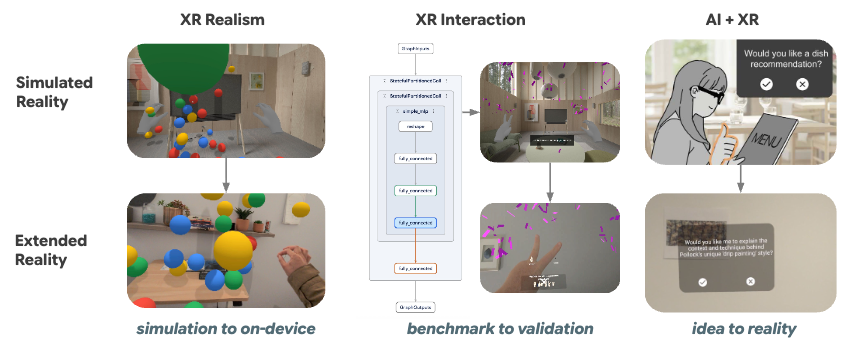

Get ready to witness a significant leap forward in the convergence of Artificial Intelligence (AI) and Extended Reality (XR). Google Research recently unveiled XR Blocks, a new open-source framework designed to dramatically simplify and accelerate the development of generative AI experiences for spatial computing platforms like AR headsets and VR environments. This isn’t just about adding AI to XR; it’s about building tools that allow creators to intuitively shape and manipulate AI-generated content within immersive 3D spaces.
Understanding the Core of XR Blocks
XR Blocks, at its core, represents a collection of pre-built components and workflows specifically tailored for creating generative AI applications within XR environments. Essentially, it functions as a visual programming environment combined with powerful AI tools—a configuration accessible even to those without extensive coding experience. The framework leverages existing generative AI models, such as diffusion models commonly used in image generation, making them readily deployable and interactive inside AR/VR spaces.
The key innovation lies within the abstraction layer XR Blocks provides. Instead of grappling with complex code, developers can visually connect blocks representing different AI operations—generating textures, creating 3D objects, modifying environments—and then directly interact with these processes within an XR environment. Consequently, this opens up possibilities for real-time content creation and manipulation that were previously difficult to achieve.
Key Components and Capabilities
- Visual Scripting: A node-based editor empowers users to define AI workflows visually, significantly minimizing the need for traditional coding approaches.
- Pre-built Blocks: Offers ready-to-use components for common generative AI tasks, including image generation, 3D model creation, and environment manipulation, streamlining development.
- Real-time Interaction: Enables users to directly influence and modify AI-generated content within the XR experience, fostering iterative design processes.
- Cross-Platform Compatibility: Designed to function across various XR platforms and devices, ensuring broader accessibility.
- Open Source Nature: The framework’s freely available nature fosters community collaboration and encourages innovation in XR Blocks development.

The Transformative Potential for XR Development
The introduction of XR Blocks holds profound implications for the future of XR development. Previously, creating sophisticated AI-powered XR experiences was a resource-intensive process often requiring specialized expertise in both AI and spatial computing. XR Blocks significantly lowers this barrier to entry; therefore, more creators can participate.


Consider these potential applications:
- Rapid Prototyping: Designers can quickly iterate on XR concepts by visually tweaking generative AI parameters in real-time.
- User-Generated Content Creation: Empowering users to create their own AR/VR content without requiring coding skills, expanding creative possibilities.
- Personalized Experiences: Generative AI can dynamically adapt XR environments and content based on user preferences and interactions, enhancing engagement.
- Novel Entertainment Formats: Interactive storytelling, immersive gaming, and personalized training simulations become more accessible with XR Blocks.
Google highlights potential use cases spanning architectural design (generating 3D building models) to educational experiences (creating interactive learning environments). The possibilities are remarkably vast.
Addressing Challenges and Envisioning Future Growth
While XR Blocks offers immense promise, certain challenges remain. Generative AI models can be computationally demanding, potentially straining resources on mobile XR devices; consequently, optimizing performance and reducing latency will be crucial for ensuring seamless user experiences. Furthermore, ethical considerations surrounding generative AI—such as potential bias in generated content and misuse—must be addressed proactively.
Looking ahead, we can expect several advancements:
- Integration with Advanced AI Models: XR Blocks will likely evolve to support newer and more sophisticated generative AI architectures.
- Expanded Block Library: The collection of pre-built components is expected to grow, catering to a broader range of XR development needs.
- Community Contributions: Leveraging the open-source nature to encourage developers to create and share custom blocks and workflows will be key for ongoing innovation with XR Blocks.
The release of XR Blocks marks a pivotal moment in the convergence of AI and XR, paving the way for more intuitive, accessible, and immersive spatial computing experiences.
Source: Read the original article here.
Discover more tech insights on ByteTrending.
Discover more from ByteTrending
Subscribe to get the latest posts sent to your email.